





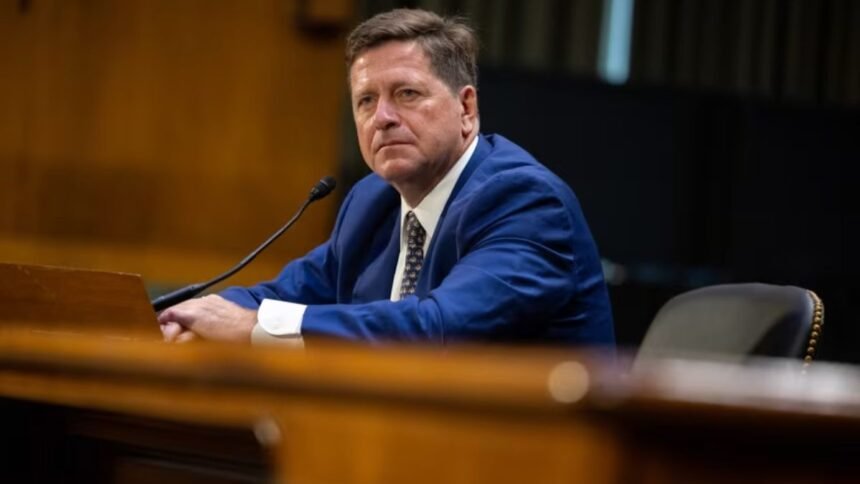
President Donald Trump has appointed Director of National Intelligence Jay Clayton to lead a new White House task force focused on the future of artificial intelligence.
The group, officially called the “Super Intelligence Force,” will examine the risks and opportunities created by advanced AI and consider what role the federal government should play in overseeing the rapidly developing technology. The task force is expected to deliver its findings within 120 days.
Jay Clayton Takes on AI Role
Clayton, who currently serves as the nation’s top intelligence official, will effectively take on the role of Trump’s AI czar through the new task force.
The administration says the goal is to make sure the United States remains a global leader in advanced AI while protecting American interests. Clayton has argued that falling behind other countries in the development of advanced AI could create additional national security risks.
The task force will examine both the potential benefits and dangers of the technology, including how the government currently responds to AI-related security incidents.
Task Force Will Study AI Risks and Government Oversight
One of the group’s responsibilities will be to review how incidents involving AI are reported to federal agencies.
That includes issues such as security breaches, hacking attempts and attempts to bypass safeguards built into AI systems. The task force will also look at ways the federal government could improve its response using authorities that already exist.
The panel will examine current laws as well as possible steps Congress could take in the future. At the same time, the administration has emphasized the need to avoid regulations that could slow technological development or weaken America’s position in the global AI race.
Trump Favors Industry Self-Regulation
The creation of the task force comes shortly after Trump met with executives from some of the country’s largest technology companies.
Those companies agreed to a voluntary framework that includes measures such as internal safety monitoring and independent reviews of AI systems. Trump has generally favored allowing the industry to play a major role in regulating itself rather than imposing broad new federal rules.
During a recent discussion about AI regulation, Trump said companies should engage in significant self-regulation while existing federal agencies and laws continue to address problems that arise.
Who Will Work With Clayton?
Clayton will not be working alone. The task force includes several senior administration officials, with Vice President JD Vance and Defense Secretary Pete Hegseth among those involved.
Other key figures include Federal Trade Commission Chair Andrew Ferguson, Under Secretary of War for Research and Engineering Emil Michael and Office of Personnel Management Director Scott Kupor.
The group will also have access to outside advisers with experience in technology and national policy, including former AI czar David Sacks and former Secretary of State Condoleezza Rice.
Why the Move Matters
The decision comes as concerns over advanced AI continue to grow in Washington and across the technology industry.
Supporters of stronger oversight argue that increasingly capable AI systems could create risks involving cybersecurity, employment, misinformation and national security. At the same time, technology companies and their supporters warn that excessive regulation could slow innovation and allow competitors such as China to gain an advantage.
The Trump administration is attempting to balance those competing concerns by focusing on America’s leadership in AI while relying heavily on voluntary safeguards and existing government authorities.
The new task force will now have 120 days to assess the government’s current approach and recommend how the United States should respond as AI systems become more powerful.